DCBA.
Danza Contemporánea Buenos Aires | Difusión Cuerpo Arte| Ciudad de Buenos Aires - Argentina


Trio A in Buenos Aires: a historical event of contemporary dance
By: Laura Lorena Feijoó - lauralorenafeijoo@gmail.com
Revised translation: Marina Giancraspo

For the first time in Argentina, Yvonne Rainer's emblematic piece arrived at the local scene by the hand of Marina Giancaspro, in what Marina called "Dance Document," which transformed the act of dancing into a profound exercise of transmission.
Trio A in Buenos Aires: The Void That Is Filled
For years, Trio A was an elusive work for me. I knew it through references, quotes in dance theory texts, the historic film, but always from a distance. I had no access to its direct experience, its bodily materiality, the process that had generated it. In my career as a dance scholar, Trio A represented many questions that I tried to answer through my own body and my own reflection. But that access remained limited, fragmentary. There was a void.
On Sunday, November 16th that void was filled. Marina Giancaspro presented Trio A at Colón Fábrica, in the neighborhood of La Boca. And with that presentation came something more than a performance: it brought the living transmission of an artistic genealogy that crosses decades, oceans, and generations.
Yvonne Rainer and Judson Dance Theater
To understand what happened at Colón Fábrica that Sunday, it's necessary to go back to 1960s New York. Yvonne Rainer, born in San Francisco on November 24, 1934, trained with Martha Graham and Merce Cunningham before becoming one of the most radical voices in postmodern dance. On Manhattan's Lower East Side, specifically at the Judson Memorial Church in Greenwich Village, an extraordinary collective of dancers, visual artists, composers, and filmmakers gathered: the Judson Dance Theater. There, figures like Trisha Brown, Lucinda Childs, Steve Paxton, Robert Rauschenberg, and Rainer herself challenged the conventions of dance, rejecting virtuosity and narrative to embrace everyday movement, improvisation, and interdisciplinary experimentation.
In 1965, Rainer wrote his celebrated "No Manifesto," a radical text declaring her rejection of spectacle, virtuosity, seduction, and glamour. A year later, in 1966, she created Trio A as part of The Mind is a Muscle, Part I. The piece is a continuous sequence of approximately five to six minutes, without music (although it allows for variations by the author) without dramatic pauses, and without eye contact with the audience. The dancer avoids the conventional relationship between performer and spectator, proposing instead a stripped-down dance where movement exists for its own sake. Trio A embodies Judson's revolutionary principles: a democratic dance, without hierarchies, without spectacle.
It was a milestone in the history of contemporary dance. Along with the Judson Dance Theater and the No Manifesto, it represented a fundamental break with previous tradition.
Marina Giancaspro: a background in experimentation
Marina Giancaspro arrived in New York in the 1980s, when Merce Cunningham's teaching dominated the experimental dance scene. She trained for years in the Professional Training Program at the Merce Cunningham Studio. There, she experienced firsthand what an education based on research into movement, space, and time truly means. Upon returning to Argentina, she became a teacher, instructing at the CTBA, IUNA, and various independent dance companies. Since 2023, she has been the artistic deputy director of the National Contemporary Dance Company.
But her introduction to Trio A is recent. Marina traveled to New York again to learn the piece. Because Trio A isn't learned just any old way or by just anyone. Yvonne Rainer established strict rules for its transmission: only authorized teachers can teach it. Marina studied with Shelley Senter, recognized as an official transmitter of Rainer's work, dancer with Trisha Brown's company, choreographer and movement researcher. But an important encounter happened later: Yvonne Rainer received Marina at her home and after that she came to see her at rehearsal. She gave her the final adjustments, those minute and fundamental details that only she could offer. As Marina recounted at the presentation, those were hours of extraordinary intensity, where Rainer's gaze "pierced the very core of the organism," as if molding "a new instinct."
Marina tells DCBA that she deliberately called this process a "dance document" rather than a performative lecture, a distinction that reveals profound methodological choices. Her conceptualization points to a logic of presentation where "the need was to bring those sounds, images, texts, and dance closer together in the way you open a box of Polaroid photos and spread them out on a table and tell the story of those materials." This metaphor expresses something crucial: the dance document doesn't prioritize verbal discourse but rather integrates all the elements equally (the piano stool, the body's positioning in space, the gazes toward the screen) into a unified program. Marina emphasizes the importance of every detail: "That's why I was sitting on a piano stool and not at a small table with a glass of water, as in a lecture." The body that reads, turns, and looks thus becomes part of the document itself, not a secondary support for a discourse. "That rescue of the closeness of the possibility of seeing the body, when reading, when turning, to look at the same thing we are all seeing at that moment, is also part of the construction of that document." What is being demanded here is the recognition that documenting dance operates according to different logics: lived embodiment and movement are legitimate forms of knowledge that deserve terminological precision.
That learning process, that living Rainer-Senter-Giancaspro genealogy, is what Marina decided to share with us at Colón Fábrica.
The event: speak, show, dance
Marina's proposal was not simply to perform the piece three times. It was, above all, a pedagogical and generous act of transmission
She began by speaking. With a measured, sometimes breathless voice, Marina told us about her trip to New York, about meeting Shelley Senter, about how she came to know the piece day by day. She showed us documents, archives of her process, photographs of the Cunningham Studio, and records of her learning. She allowed us access to the intimacy of her research: how her body emotionally grasped the folds, the falls, the twists, the extensions of Trio A. She explained the historical context of “The Judson”, the names of those who participated in its creation, the radical nature of Rainer's proposal. It was a masterclass on the work and on the process of its transmission.
Then Marina danced the first version. Without music, just as Rainer originally conceived it in 1966. The silence was complete. Only the body moving in space, the continuity of the flow, the absence of climax or hierarchies within the choreographic sequence. It was like seeing the archive in motion, the origin embodied.
Once again, Marina spoke. This time she shared her personal learning experience. How a dancer's body is slowly inhabited through repetition, how affective knowledge emerges. She described the moments of rupture, of revelation, when she finally understood a passage not from the head but from the bones.
The second version arrived accompanied by music (In the midnight hour played by The Chambers Brothers). Trio A admits it; Rainer allowed variations. Marina's body now moved under another temporal dimension, within two different rhythms. It was the same Trio A, but different. It was the Trio A she had incorporated through the encounter with Senter, with Rainer, with this song filling out the space of Colón Fábrica.
A third time, Marina spoke. This time about Yvonne, with genuine affection. It was evident in her voice. She recounted details of her encounter with the choreographer, intimate moments, lessons that went beyond the technical. She prepared us for what was to come.
The third version of Trio A took place in collaboration with Andrea Fernández. Andrea didn't dance the piece, but rather inhabited the space, filling it with her presence. She introduced another Trio A, one with the other. The relational space was activated. It was evident that Marina wasn't dancing in isolation, but in dialogue. The final gesture was that: proof that dance, even a dance as stripped down as Trio A, is completed in relationship, in the presence of the other.
The closing: filling the void
When Marina finished, I remained in that space for a moment. That void that had accompanied me for years while studying Trio A from afar had been filled. Not by more information, but by something more fundamental: by the experience of honest, rigorous, loving transmission.
Marina had given us more than a performance. She had given us access to a process, a genealogy, the intimacy of how a work lives when it is transmitted with true commitment. She danced the archive, yes. But more importantly, she opened up her sensitivity, her way of knowing, her way of being in dance.
For me, each viewer brings their own meaning to the work. My conclusion is this: what Marina demonstrated is that artistic genealogies can cross oceans and decades. That transmission, when done with rigor, sensitivity, and love, not only fills the gaps but also generates something entirely new. A responsibility, a duty to remember, a shared joy.
Sunday at Colón Fábrica wasn't just the premiere of a landmark work in Argentina. It was proof that we are complete when there is another. That true knowledge isn't transmitted solely through information, but through the body, the voice, the generous presence of the one who teaches.
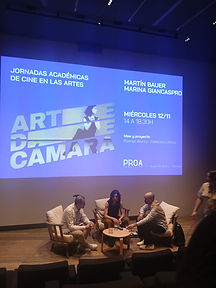

Photos courtesy of María José Yancomay